Social Learning: The Art of War (And Leadership)
By: Patrick Yambrick
Published: Friday, Mar 13, 2026
Last Edit: Sunday, Mar 15, 2026
Edit Sun, Mar 15, 2026: Edits in This Color.
Rather than edit this part, I am going to leave my original writing and address it here. I referred to the attack on Temple Israel as "The West Bloomfield Miracle". I did not properly consider the implications of that statement before posting. I do not believe that any attack on any house of worship should be framed as a "Miracle."
For those of Jewish descent and faith, the smoke inhalation while confined and fearing for one's life will have had a much more traumatic impact on its survivors than I initially considered. Labeling a threat to your lives as a "Miracle" was a profound misjudgement on my part. I hope that you can forgive me and appreciate my apology; I accept it if you cannot or will not.
As I will explain later, part of my intent with this set of posts is to explore common tactics used by adversaries at war - many of which lie within the realms of deception and manipulation. I am not a doomsday prepper, nor do I believe that WWIII is a foregone conclusion - though I do believe it is better to be safe than sorry. Perhaps you do, too? If so, then continue on.
In later posts, we will explore how emotional narratives can be used to skew perceptions of events - effectively bending reality within the minds of the susceptible - myself included, at times. Teaching cognitive defense via inoculation is really only a side-effect of my primary intent.
My deepest intent is to teach and to grow, while exploring the social issues which I see around me in a constructive, not destructive, way. I never aim to subject my audience to traumatic experiences - especially unawares. I am thankful that there have been no resultant casualties beyond the assailant - that was my intent.
I'll stop talking now and commence with the doing better.
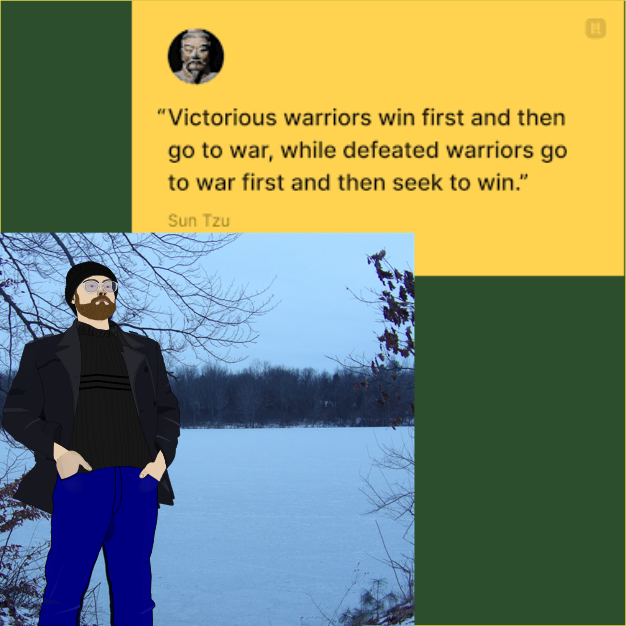
III. Attack by Stratagem - The Art of War
Sun Tzu said: In the practical art of war, the best thing of all is to take the enemy's country whole and intact; to shatter and destroy it is not so good. So, too, it is better to recapture an army entire than to destroy it, to capture a regiment, a detachment or a company entire than to destroy them.
Hence to fight and conquer in all your battles is not supreme excellence; supreme excellence consists in breaking the enemy's resistance without fighting.
Thus the highest form of generalship is to balk the enemy's plans; the next best is to prevent the junction of the enemy's forces; the next in order is to attack the enemy's army in the field; and the worst policy of all is to besiege walled cities.
The rule is, not to besiege walled cities if it can possibly be avoided. The preparation of mantlets, movable shelters, and various implements of war, will take up three whole months; and the piling up of mounds over against the walls will take three months more.
The general, unable to control his irritation, will launch his men to the assault like swarming ants, with the result that one-third of his men are slain, while the town still remains untaken. Such are the disastrous effects of a siege.
--Start Disclaimer--
Privacy disclaimer before clicking on any embedded songs or videos in this post: although I track no data on you when you use these embeds, the services from which I source them do. If you are curious to learn more, check out the Contact Page. All music, videos, and their relevant rights belong to the original creators and posters, and to the relevant hosting sites. If I need to take anything down, you already know how to find the contact page. Let me know.
I take a lot of Chances in this article. My intent is to channel the original artists' creativity with the intent of emphasizing the point I am making. I believe that wisdom can be drawn from many sources.
To my knowledge, what I am doing qualifies as fair use. I am happy to remove any content which I have embedded which violates fair use. I am not a lawyer, and I make no money off of this content. Let Me Know.
--End Disclaimer--
What Is Social Learning?
Before we move too far ahead, let me explain why it is that I choose to employ the style that I employ in my posts.
According to This Article, social learning is the process of learning through observation, imitation, and modeling.
At the risk of sounding base, this is like "Monkey see, monkey do."
Scientifically: think about mirror neurons. We all have them. When we see someone doing something which we perceive as strong, noble, or admirable, we all feel the pull to mimic some piece of that, through our own lens.
When those we are trained to admire are behaving their best, this is good for us all. When they are being chaotic or violent, this pulls us apart at our very seams.
Ever played with a Chinese Finger Trap? It's a little like that.
Back to the point:
Developed by a psychologist called Albert Bandura, Social Learning Theory forms the bedrock for what is now called Social Cognitive Theory.
Whatever it is called, the principles remain similar enough that, unless you are really curious, or looking to become an expert, this overview should suffice. If you'd like to learn more, feel free to dig into the links provided here to read from more authoritative voices on the subject.
In this theory, Bandura posits - accurately, from my perspective - that the more authoritative a model or a voice is, the more inclined the student is to listen.
Knowing this, I choose to eschew the authoritative stance strategically in spots in favor of a peerlike tone - I know many unconventional learners who have felt so burned by trusted authorities that they revile at the hint of authority. My website traffic demonstrates this to me effectively. I will explore how that is in a later post.
I compose my content in this way because of the implications of articles Like This, on the impact social media algorithms have on our perceptions.
A Tl;Dr on that goes something like: as an algorithm filters content, it receives feedback about your preferences, and the cycle continues and recursively filters the already filtered content based once again on your reactions, and then feeds you back more and more heavily filtered content.
That becomes a rabbit hole - for better or for worse - really quickly.
Since this is happening to you (and to me), it is safe to assume that it is happening to those around us, as well, especially if we are sharing the content we find at the bottoms of those rabbit holes without warning our friends that we have been guided there by the power of the algorithm - remember those mirror neurons.
Through the shared experience of being heavily filtered and mirrored back to, we wind up teaching ourselves untruths about the level of hate or whatever other negativity that is present in the world around us.
Make no mistake: those things are present. They haven't disappeared. They are real.
But the divide is not as wide as many of us have led ourselves to believe.
I - Local Scare Doesn't Go There
II - Video Games and Leadership Brains
III - How to Strike Gently
How to Apply These Lessons
Thanks for Reading
Thank you for reading 'Social Learning: The Art of War (And Leadership)'! Want to share your story or have your words heard? Reach out to me and let's discuss the possibilities.